The Angel of Safe Sex
By Nadine Epstein
It was 1987 and Scott Fried was shoveling heaps of junk from under the trap door of an off-Broadway stage. The young actor and dancer was nearing the end of a grueling apprenticeship toiling behind-in this case below-the stage in order to earn his Actor’s Equity card. “I would longingly listen to the actors above me,” he says. “All I wanted was to be one of them.”
That’s when he met “the carpenter”-an older man working on the set. He was gay and Fried, who had recently broken up with his girlfriend, became his “young find.” Fried, who grew up in what he describes as a sweet, traditionally Jewish, Long Island home, sighs: “It was my first time having unsafe sex and my first homosexual encounter.”
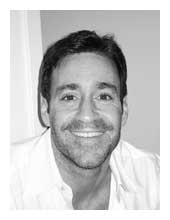
Fried is now 43. When I meet him at the Tick Tock Diner on 8th Avenue in Manhattan, he looks no more than 30, a compact, strong-bodied dancer wearing a black T-shirt and jeans. “A few months after my encounter with ‘the carpenter’-and that’s all it was, a sexual encounter,” he tells me, “I tested positive for HIV.”
About the same time, Fried received his long sought-after Actor’s Equity card. “I’d worked so hard for it,” he says without a trace of self-pity. Fortunately, the virus that leads to AIDS stayed dormant, so he went back to work, this time above the stage, for what would be a decade-long career that included a role in Joseph and the Amazing Technicolor Dreamcoat and a stint as the HIV-positive Bart Mesa in the television soap opera Guiding Light.
Meanwhile, he joined an HIV support group and along with a friend threw birthday parties for children dying of AIDS. “Once a month we’d go to a hospital or a hospice and dress up as clowns and bring a cake,” he recalls. “It was great, but the kids died so fast we didn’t wait for their birthdays. Once a nurse left a message on my answering machine: ‘I want to thank you for throwing the party for Christian. He died yesterday.’”
Disheartened by these young deaths, Fried began talking with teenagers and college students about how to avoid getting infected. His phone soon started ringing off the hook and not with audition callbacks. “I thought maybe this is a sign that this is what I should be doing,” he says. So he left acting to launch a new career as a health educator and motivational speaker; his new gigs were at middle schools, high schools, Hebrew schools, universities and Hillels all over the country. “Instead of playing a Neil Simon character I was suddenly playing myself,” he says wryly.
Fried begins by standing before his student audiences without a microphone. “I say: ‘This is what HIV looks like. What happened to me could happen to you. And it couldn’t have happened to a nicer guy.’” He talks about his own experience, complete with details that kids will remember. “I describe the brown corduroy couch at the carpenter’s apartment. I tell them that I knew I wasn’t hearing the sound of latex, the sounds of the condom wrapper-the sounds of safe sex. Young adults are craving the truth. They want to know what HIV looks like and how you get it.”
With Jewish students, he talks about God and Torah. “I believed in God before I got infected, and after,” he tells them. “My HIV infection has nothing to do with Judaism or God. It has to do with my unsafe sex behavior and my sense of aloneness as a 24-year-old.” He believes Judaism can play a crucial role in preventing teenagers and young adults from being infected by providing them with a sense of kehilla, community, and kesher, connection, as well as metaphors through which they can understand themselves. “Jacob is the figure who represents what it is to be lost and found in this life,” he says. “He is representative of what young adults go through. They wrestle with their angels, anything from drug addiction to eating disorders to parents’ divorce, and in my case, HIV.”
Fried’s late father, a health teacher, was preparing a lesson plan on HIV prevention when his son broke the news. His father told him: “I love you even more now than I did before because I know more about you.” Father and son sometimes shared the stage to talk about HIV prevention. So I can hear anguish in Fried’s voice when the subject turns to AIDS education in schools today: “When Bill Clinton was in office, teenagers at least knew about mucous membranes and the four fluids that transmit the virus. Under the Bush Administration you’ve got teenagers who don’t know how not to get infected. It’s frightening.” Jewish educators as a whole, he adds, are not doing much better than the rest. “How many more young people have to die?” he asks.
Last year, after 18 and a half years, Fried’s HIV infection “woke up.” There is no cure, but with the help of anti-viral drugs, he was soon well enough to resume his rigorous schedule of 20 speaking engagements a month.
“I’m just really lucky to have lived this long,” he tells me. “The carpenter” long ago died of AIDS, and many of Fried’s friends are gone as well. The drugs could make it possible for him to survive for many more years. “I plan to be around a long time, and at the same time I plan not to be,” he says. “All I can say is that I’m loving what I do. I just want to educate more teenagers before I die.”
© 2007 Moment Magazine